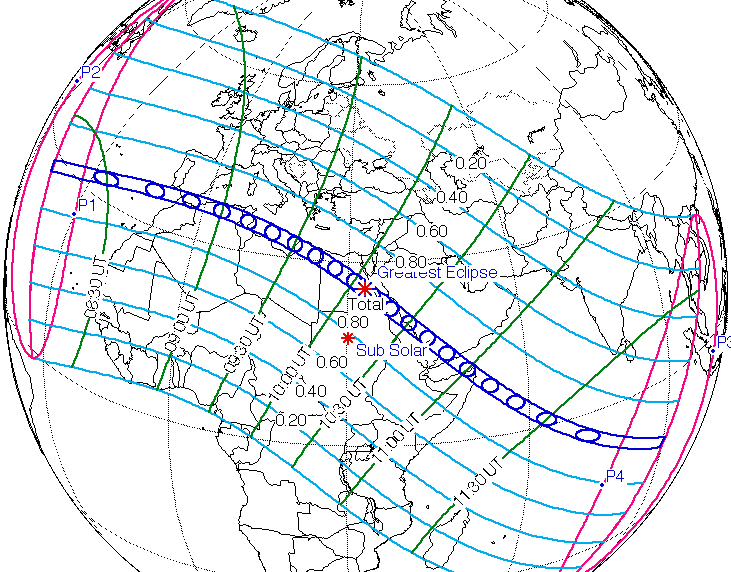
The image for this blog card was provided by NASA.
August 2, 2027. Belonging to Solar Saros 136, this total solar eclipse is one of the greatest celestial shows of the century, with the moon’s umbra sweeping across a vast expanse from North Africa to the Middle East. This is the same Saros series that produced the 1991 Hawaii-Mexico eclipse and the 2009 Tokara-Shanghai eclipse, a lineage famous for generating extremely long totalities. The maximum duration of totality for this event reaches a staggering 6 minutes and 23 seconds—the longest we will see this century. It is no wonder that astronomy fans worldwide are understandably buzzing with excitement.
Currently, countless travel agencies and self-proclaimed “eclipse experts” are flocking to recommend Luxor, Egypt, as the premier observation site. Their sole rationale: “It is close to the centerline of totality, offers the longest duration, and boasts a near 100 % chance of clear skies.” However, focusing exclusively on duration and clear sky probability while ignoring all other environmental factors is, from a data analysis perspective, the completely “incorrect answer.” Based on facts and data, this article will explain just how reckless and foolish observing in Luxor would be, and present the city that serves as the true optimal solution.
The “Luxor is Best” Theory is Pure Fantasy
In selecting an eclipse observation site, the duration of totality and the probability of clear skies are merely two of many parameters. If we analyze meteorological stability, accessibility of the observation site, safety during the stay, equipment transportation risks, and overall comfort as variables, the Luxor option is destined to be rejected right out of the gate.
Murderous Climate Data: A One-Way Ticket to Heatstroke
A glance at Luxor’s early August weather data over the past few decades makes its abnormality glaringly obvious. Day after day, high temperatures easily exceed 40 °C (104 °F) and sometimes approach 45 °C (113 °F). Even with low humidity, waiting in a shadeless desert under intense, direct sunlight is less an observation and more accurately described as a human experiment.
A total solar eclipse is not an event where you simply look up at the sky for the brief moment of totality. You must spend well over two hours and forty minutes outdoors from the beginning to the end of the partial phases. From the perspective of the Wet Bulb Globe Temperature (WBGT), prolonged outdoor activity in this environment is extremely dangerous, even life-threatening. I understand the romantic appeal of photographing the eclipse against the backdrop of magnificent ruins like the Valley of the Kings or the Karnak Temple. However, attempting to endure the progression of the eclipse in this brutal heat is a suicidal act—akin to buying yourself a one-way ticket to heatstroke.
Squandered Tourism Resources and Supremely Inefficient Access
Luxor boasts a dense concentration of the world’s premier ruins, but in this fierce heat, daytime outdoor activities are severely restricted. You can only move around in the early morning or evening; during the day, you have no choice but to waste time basking in the air conditioning of your hotel room. This is a clear squandering of a precious travel itinerary and offers an abysmally low return on investment.
Furthermore, the inefficiency of access is fatal. August is the absolute off-season for Egyptian tourism, meaning direct flights from major European cities drop drastically. Consequently, you are forced into cumbersome layovers in Cairo, exhausting massive amounts of time and energy just on travel. As the number of transits increases, the risk of lost baggage inevitably rises. Bearing the risk of losing irreplaceable observation equipment, such as equatorial mounts and telescopes, could completely derail your entire observation plan.
An Inferior Living Environment That Grinds Down Mind and Body
Regarding safety in Egypt, while it is considered stable with few violent crimes, it is a well-known fact that relentless touting targeting tourists, demands for alms (baksheesh), and malicious price- gouging are rampant. These negotiations, which unfold every time you step outside, will reliably chip away at the mental energy you should be reserving for your observation.
In addition, hygiene risks cannot be ignored. Compounded by severe physical exhaustion from the extreme heat, the contraction rate of water- and food-borne gastroenteritis (the so-called “Pharaoh’s Revenge”) is extremely high. Staying in Luxor while harboring the risk of not being in perfect physical condition on the day of the eclipse is far too irresponsible for an observer. Completely lacking the requirements for overall comfort, Luxor is utterly unqualified as a base for eclipse chasers.
The Only Optimal Solution Derived from Data
Having rejected Luxor, where should we head? When all variables are optimized, there is only one solution: Tangier, a port city in northern Morocco.
Miraculous Weather Conditions and Overwhelming Accessibility
Tangier’s August weather data shows anomalous figures that could safely be called a “miracle” within the North Africa and Middle East region. Influenced by the Canary Current, high temperatures hover around a comfortable 30 °C (86 °F). Thanks to the sea breeze from the Strait of Gibraltar, where the Atlantic Ocean meets the Mediterranean Sea, humidity is low and the climate is exceptionally pleasant. Here exists an environment where you can calmly and accurately focus on setting up your observation equipment and recording the celestial show without suffering from extreme heat.
In terms of accessibility, Tangier also overwhelms the alternatives. It is home to Ibn Battouta International Airport, which is served by an abundance of direct flights from major European cities. Furthermore, it boasts a unique route: by taking a ferry from Tarifa, Spain, you can cross the Strait of Gibraltar and arrive in just one hour. This variety of access methods serves as a powerful risk hedge against unforeseen circumstances like flight cancellations.
Flawless Security and a Cosmopolitan Cultural Experience
For eclipse chasers carrying highly expensive precision instruments worth tens of thousands of dollars, good security is an absolute, uncompromising requirement. Morocco is politically highly stable under its monarchy, and in Tangier specifically, the tourist police function exceptionally well. An environment where travelers from all over the world can stay safely day and night is entirely free from the mental fatigue found in Luxor.
Moreover, Tangier has a unique history of once being an “International Zone” administered by global powers. Because of this, a distinct cosmopolitan atmosphere permeates the city, blending sophisticated Western culture with traditional Arab-Islamic culture at every turn. Beyond mere eclipse observation, it allows for diverse cultural experiences that satisfy intellectual curiosity.
Appeal as a Tourist Hub and Endless Itinerary Options
Within the city of Tangier alone, there is an endless array of sights where history and nature converge: the labyrinthine old city (Medina), the robust Kasbah overlooking the Strait of Gibraltar, Cape Spartel located at the boundary of the Atlantic and Mediterranean, and the Caves of Hercules.
However, Tangier’s true value lies in its superb function as a hub. Day trips to fascinating surrounding cities are incredibly easy—whether it’s Chefchaouen, known for its blue streets; the World Heritage city of Tétouan, which retains vestiges of Andalusia; or the seaside artist enclave of Asilah. The combination of a comfortable climate and excellent access to diverse neighboring cities ensures that even during a long stay before and after the eclipse, you will constantly experience fresh inspiration and never find yourself with too much time on your hands.
Discard Emotion and Choose Your Site with Logic!
Those who are seduced by the sweet-sounding phrases “long duration of totality” and “high probability of clear skies” and choose Luxor have completely failed to calculate the risks of exposing their bodies and minds to such a harsh environment. While astronomical data must certainly be respected, we must not forget the fact that we are flesh-and-blood humans, bound by the constraints of the physical and social environments on Earth.
For the total solar eclipse on August 2, 2027, the logical conclusion for achieving both reliable observation and a comfortable stay is a trip to Tangier—and nowhere else. Only those who calmly analyze the data and eliminate all risks will be able to perfectly enjoy the cosmic mystery brought by the black sun, amidst the cool breeze blowing through the Strait of Gibraltar. Discard emotion and romance; choose your observation site with logic. That is the only course of action a true eclipse chaser should take.
コメント